Welcome to Kitabi.net - Kitabi is Arabic for Book
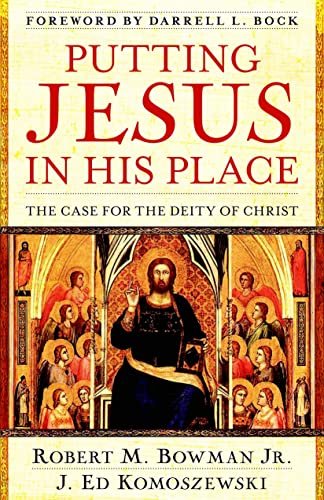
Putting Jesus in His Place - The case for the deity of Jesus
by Robert M. Bowman Jr and J. Ed KoMoszewski
The Deity of Jesus – this books ends the argument
I have had a lot of discussions with Muslims and Jehovah’s Witnesses over the years about the subject of the deity of Jesus Christ and I thought I had become a bit of an expert and even considered writing a book about it. Then I came across a book by Robert M. Bowman called Putting Jesus in his place – subtitle The Case For The Deity Of Christ. This book has ended all debate on the subject of the deity of Jesus and has certainly removed the need to write a book on it myself - which at least saves me a job.
Some brief details about the author and the co author J. Ed Komoszewski. Bowman has a MA from Fuller Theological Seminary and was a lecturer for five years at Biola University. He has written 11 books including the Gold Medallion award winning book “Faith has it’s reason”.
Komoszewski has a masters in theology from Dallas Theological Seminary and is the founder of a research organisation known as Christus Nexus.
One of the things that impressed me about the book is even though it is written by scholars, it is written in a style that is easy reading for the non-scholar. Any advanced subjects are explained and no assumptions are made about the previous knowledge of the reader. And yet at the same time they stay true to their academic roots.
What the authors have done is base their framework around an acronym of HANDS. That is to say that
H stands for honour – Jesus shares the honours due to God.
A is for attributes - Jesus shares the attributes of God.
N is for names - Jesus shares the names of God.
D is for deeds - Jesus shares in the deeds that God does.
S is seat - Jesus shares the seat of God’s throne.
Them what they do is go through these points one by one, expanding on how the scriptures reveal these truths to us. Bit by bit the picture is built up so that any one of these subjects alone is sufficient to reveal that Jesus is God but add them together and you have an avalanche of evidence for the deity of Christ.
One of the things I liked about the book was that the authors did not use over simplistic arguments. Often the evidence is found in the context of the passage. For example we can not simply say that calling Jesus the judge makes him God because there are many judges in the world and we don’t make them into a God. The difference is the context of the reference and also when the account refers to a unique role that applies to God only. While they may be earthy judges we all instinctually know that God will be the ultimate judge, but to confirm that from scripture lets look at the following examples.
Taking God as the judge.
Psalm 96:12-13 “Let the fields be jubilant, and everything in them; let all the trees of the forest sing for joy. Let all creation rejoice before the Lord, for he comes, he comes to judge the earth. He will judge the world in righteousness and the peoples in his faithfulness.”
Jeremiah 25:31 “The tumult will resound to the ends of the earth, for the Lord will bring charges against the nations; he will bring judgment on all mankind and put the wicked to the sword,’ ”
Joel 3:12 “Let the nations be roused; let them advance into the Valley of Jehoshaphat, for there I will sit to judge all the nations on every side.”
And for Jesus;
Matthew 16:27 “For the Son of Man is going to come in his Father’s glory with his angels, and then he will reward each person according to what they have done.”
John 5:22-23 “Moreover, the Father judges no one, but has entrusted all judgment to the Son, that all may honor the Son just as they honor the Father. Whoever does not honor the Son does not honor the Father, who sent him.”
So we see it is the context and more so in this case, the uniqueness of the role of being the judge of the whole world that speaks of the deity of Jesus. The book is packed with example after example like this.
One of the comments the book makes which is worth quoting is
“The new Testament does call Jesus God as we have seen but even if it did not, something like 99% of the Biblical evidence for the deity of Christ would remain untouched.” (page 268).
What the authors are saying is that even though the Bible contains straight forward statements that declare the deity of Jesus such as “In the beginning was the Word, and the Word was with God, and the Word was God. He was with God in the beginning. Through him all things were made; without him nothing was made that has been made.” and the statement by Thomas “My Lord and my God.” That even so there is other much larger amount of Biblical evidence for the Deity of Christ. That scale of evidence is much larger than even I had imagined. I found myself reading passages that I had read many times in a new light having missed the inescapable evidence within it for even more revelation about the deity of Jesus. In fact the evidence is so large, it has to be said that it is foolishness to deny the deity of Jesus on the basis of the what the Bible says.
The authors don’t just present evidence for the deity of Jesus but they also cover well known objections – in particular those of other scholars but they do this in a respectful manner. Of a less scholarly nature they have things to say about is the often quoted myth that the deity of Jesus was invented by the Nicene Council in 325 AD. In their conclusion they have this to say.
“The case for the deity of Christ does not rest on a few proof-texts. The popular notion that some fourth-century Christians decided to impose on the Church a belief in Jesus as God and wrenched isolated Bible verses from their contexts to support their agenda is a gross misrepresentation of the facts. The framers of the orthodox doctrines of the Incarnation and the Trinity did have an agenda, but it was not to replace a merely human Jesus with a divine Christ. Their agenda was to safeguard the New Testament’s clear teaching of the deity of the Lord Jesus Christ in a way that did equal justice to three other clear teachings of the Bible: there is only one God; Jesus is the Son and not the Father; Jesus is also a human being. (page 267).
To sum up, This is an excellent book, packed with information that totally settles the issue of the deity of Jesus. It is good to read and then keep on you bookshelf as a future reference with a good reference at the back that can be referred to to look look up key Bible verses on the various subjects. I strongly recommend it. If you want a book on the subject of the deity of Jesus then this has all the bases covered and is well worth investing in.